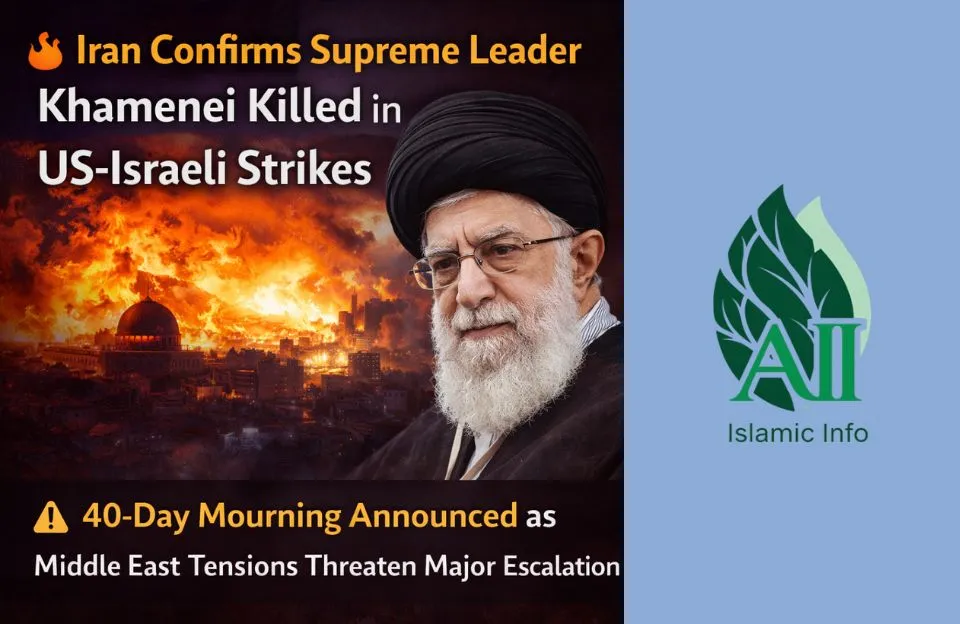
Iran Confirms Supreme Leader Ali Khamenei dead After US-Israeli Airstrikes
Iranian state television has officially confirmed that the country’s Supreme Leader, Ayatollah Ali Khamenei killed during joint air strikes on Iran carried out by the United States and Israel. The announcement ends hours of conflicting reports and marks one of the most dramatic turning points in Iran’s modern political history.
According to Iranian state media, Khamenei was targeted at his office during coordinated attacks that began early Saturday. A nationwide 40-day mourning period has been declared in honor of the 86-year-old leader, who had ruled Iran since 1989.
Conflicting Reports Before Official Confirmation
Earlier in the day, Iranian news agencies Tasnim and Mehr had reported that Khamenei remained “steadfast” and actively oversaw developments despite the escalating conflict. However, the situation shifted after statements from US and Israeli officials indicated the Iranian leader killed in the strikes.
US President Donald Trump posted on his Truth Social platform that Khamenei had died in what he described as highly coordinated operations involving advanced intelligence tracking systems. He stated that the strikes were conducted in close collaboration with Israel and claimed that several other senior Iranian leaders were also eliminated.
Trump described the moment as a potential turning point for the Iranian people, suggesting it could open the door for political change within the country.
Meanwhile, Israeli Prime Minister Benjamin Netanyahu had earlier said there were “growing signs” that the Iranian leader had been killed. International news agency Reuters, citing an unnamed senior Israeli official, also reported that Khamenei’s body had been located prior to Iran’s confirmation.
A Leadership Era That Began in 1989
Khamenei became Iran’s Supreme Leader following the death of Ruhollah Khomeini, the architect of the 1979 Islamic Revolution. As Supreme Leader, Khamenei held ultimate authority over Iran’s executive, legislative, and judicial branches, as well as command of the armed forces and oversight of the country’s nuclear program.
His leadership spanned more than three decades and shaped Iran’s domestic and foreign policy, particularly its tense relationship with the United States and Israel.
What Happens Next in Iran?
Political analysts say Iran has contingency plans in place for such a scenario.
Khamenei’s death, however, introduces deep uncertainty into an already volatile regional conflict. Observers warn that power struggles within Iran’s political and military leadership could further destabilize the situation.
Escalating Military Confrontation
Attack on Iran reportedly killed Khamenei and was part of a broader military campaign targeting multiple locations across Iran. Iranian media, citing the Red Crescent, reported that attacks hit 24 provinces and resulted in at least 201 deaths.
Among the reported casualties were civilians, including children. Israeli airstrikes allegedly targeted two schools, including the Shajareh Tayyebeh girls’ elementary school in the southern city of Minab, where more than 100 people were reported killed. Additional strikes were said to have occurred near Tehran.
Netanyahu claimed that Israeli forces eliminated several senior Revolutionary Guard commanders and officials associated with Iran’s nuclear program. He indicated that military operations would continue.
Trump also suggested that “heavy and pinpoint bombing” would proceed for as long as deemed necessary.
Iran’s Retaliation and Regional Fallout
In response, Iran launched retaliatory strikes targeting US and Israeli positions. The Islamic Revolutionary Guard Corps (IRGC) announced that multiple waves of counterattacks were underway. Air-defense systems were activated in several Gulf states hosting US military assets, including Kuwait, Qatar, the United Arab Emirates, and Bahrain.
The rapid escalation has heightened fears of a broader regional war involving multiple countries.
Global Calls for De-escalation
At an emergency meeting of the United Nations Security Council, Secretary-General Antonio Guterres expressed deep concern over the unfolding crisis. He warned that continued military action could ignite uncontrollable consequences in an already volatile region and called for an immediate ceasefire.
Iran’s UN ambassador accused the US and Israel of launching what he described as an unprovoked and premeditated attack on civilian-populated areas. He labeled the strikes a violation of international law.
In contrast, the US ambassador to the UN defended the operation, arguing that preventing Iran from acquiring nuclear weapons remains a matter of global security.
China and Russia also voiced strong concern. Beijing warned against further escalation, while Moscow condemned the airstrikes and demanded an immediate halt to military operations.
A Region on Edge
The confirmed death of Ali Khamenei marks a historic and potentially destabilizing moment for Iran and the Middle East. As the 40-day mourning period begins, the world watches closely to see how Iran’s leadership transition unfolds — and whether diplomatic channels can prevent a wider conflict.
With tensions already high, the coming days are likely to determine whether the crisis moves toward de-escalation or deeper confrontation.