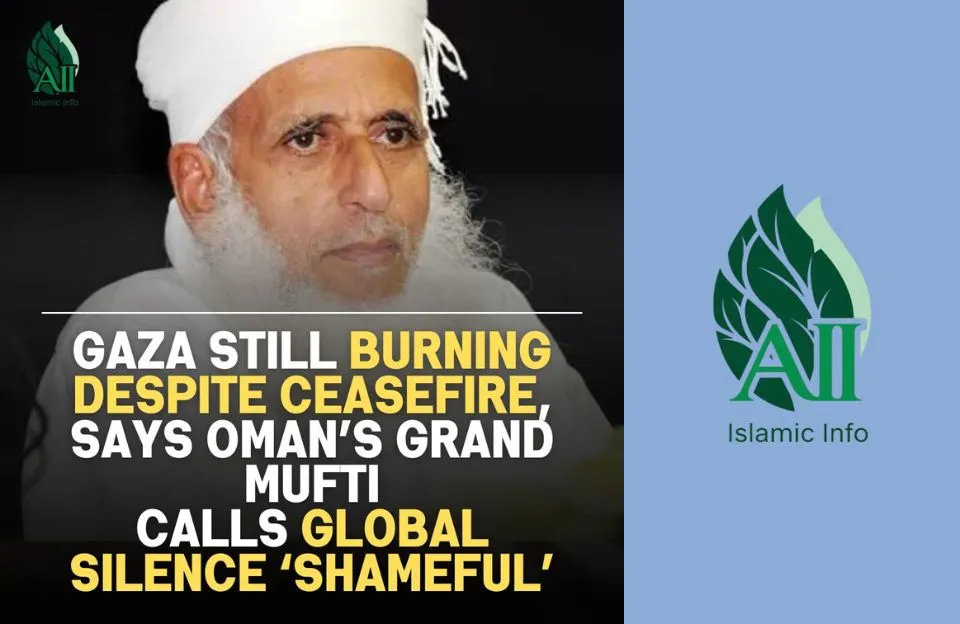
Grand Mufti of Oman Warns Gaza Ceasefire Has Failed as Israeli Attacks Intensify
Grand Mufti of Oman, Sheikh Ahmed al-Khalili, has strongly condemned the ongoing Israeli assault on Gaza, stressing that the recently announced ceasefire has produced “no real results” and has failed to stop the violence, especially in the heavily targeted city of Rafah.
In a statement posted on X (formerly Twitter) on Wednesday, al-Khalili expressed deep concern over the relentless attacks on Palestinians, calling the situation unbearable and morally unacceptable. He criticised the countries involved in ceasefire negotiations for their lack of decisive action, and also questioned the silence of the broader international community — including several Muslim nations.
The Grand Mufti urged world leaders to act immediately to halt Israel’s aggression, while appealing to “the free and just people across the world” to continue standing with Palestinians. Remaining silent, he said, is “a disgrace that history will not forgive,” as he asked, “How long must this suffering continue?”
According to rights groups and humanitarian agencies, Israel — backed by the US and several European governments — has been conducting a devastating military campaign across Gaza since October 7, 2023. The offensive has included widespread bombing, mass displacement, starvation tactics, and the destruction of civilian infrastructure, despite repeated international appeals and rulings from the International Court of Justice (ICJ).
Updated figures indicate that more than 241,000 Palestinians have been killed or injured, the majority being women and children. Over 11,000 people remain missing, many believed to be under the rubble. The starvation deaths of already diseased children and the destruction of complete neighborhoods and entire cities continue.
Humanitarian organizations cite the ongoing conflict in the Middle East as one of the greatest humanitarian catastrophes of our time as the situation in Gaza escalates. Activists are that the most devastating crises of the modern world appear to be aggravating rather than alleviating.
Humanitarian groups working on the ground report that the daily situation in Gaza continues to deteriorate despite international discussions about peace. Aid convoys remain restricted, hospitals are overwhelmed, and thousands of displaced families are living in makeshift shelters without proper food, water, or medical supplies. According to relief workers, the ceasefire agreement has done little to change these harsh realities, as Israeli raids and airstrikes continue to endanger civilians in multiple parts of the enclave.
Sheikh al-Khalili emphasised that the world must not be deceived by symbolic agreements or political statements that fail to address the core issue — the immediate need to stop the violence and protect innocent lives. He asserted that peace can never be attained without acknowledging and prosecuting war criminals and securing justice for the Palestinian people. He also mentioned that young people, especially, leading the global movements for solidarity and change, have become instrumental in the fight against tyranny and oppression and are encouraged to continue such activism.
Regional analysts say these comments indicate rising exasperation in many countries in the Muslim world, especially as the ceasefire is perceived as a tactical maneuver and not a means to end the violence. With the humanitarian crisis in Gaza growing more severe, there is an urgent and escalating call for meaningful international intervention to stop the ongoing humanitarian catastrophe; that call is growing from religious and civil leaders, human rights campaigners, and ordinary citizens alike.