Gaza Peacekeeping
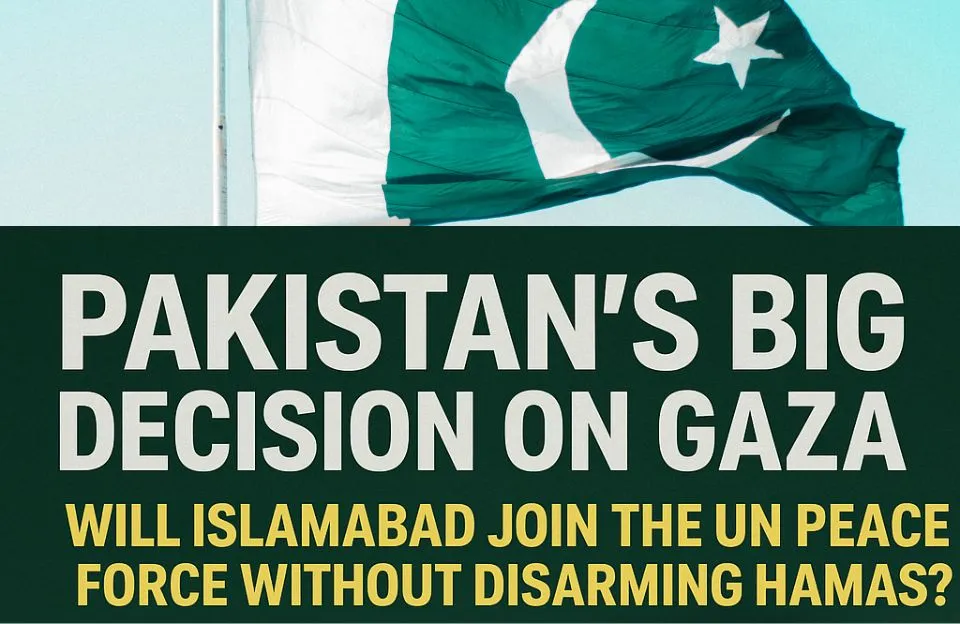
Pakistan is once again walking a diplomatic tightrope as discussions intensify over the possible deployment of Pakistani troops to Gaza. Defense Minister Khawaja Muhammad Asif has made one point unmistakably clear: Pakistan will not be part of any mission that requires the disarmament of Hamas. This stance reflects both political sensitivity at home and a broader commitment to a unified Muslim position on the Gaza crisis.
The proposal under review involves Pakistan joining a United Nations–mandated International Stabilization Force (ISF)—a key component of the post-ceasefire plan supported by the Donald Trump administration. The concept gained formal backing through UN Security Council Resolution 2803, adopted on November 17. This resolution supports the initial phase of a 20-point strategy aimed at securing the ceasefire, opening humanitarian corridors, and preparing Gaza for reconstruction, while postponing the most contentious political issues.
Although Islamabad voted in favor of the resolution, Pakistan’s UN representative, Asim Iftikhar Ahmed, voiced reservations, noting that several important suggestions from Pakistan were not included. He stressed that the government expects more clarity in the coming weeks.
Pakistan’s Possible Troop Contribution Still Under Consideration
The debate within Pakistan has intensified in recent days. Defense Minister Asif confirmed that consultations with all key stakeholders—civilian and military—are underway, and that a final decision will be taken soon.
Foreign Minister Ishaq Dar, addressing parliament, revealed that Indonesia has already offered 20,000 troops for the peace force. He also noted that the ISF could be the most important possible stabilizing mechanism since the UN and the OIC have not been able to achieve peace. “With the U.S., we can see an end to the war,” Dar remarked—an unusual but telling statement about shifting diplomatic dynamics.
Pakistan’s cautious wording is intentional: the country is neither committing to the mission nor rejecting it outright. Instead, Islamabad is positioning itself within the growing consensus of eight influential Muslim nations—Egypt, Jordan, Qatar, Saudi Arabia, the UAE, Türkiye, Indonesia, and Bahrain—who together helped broker the recent ceasefire between Hamas and Israel.
Their joint statement issued on October 5 supported Gaza–West Bank unity, a full Israeli withdrawal, reconstruction of Gaza, and progress toward a two-state solution. Pakistan has repeatedly stated that any troop deployment will be aligned with these Muslim nations’ collective decision.
Asif described potential Pakistani participation as “a moment of pride,” suggesting that playing a role in protecting Palestinians would be an honor for the country.
Key Challenges: Lack of Clarity and Domestic Sensitivities
Even with the springing diplomatic momentum, major concerns remain. There are major concerns regarding the mandates of the proposed stabilization forces that remain vague, causing major questions to arise. Is the mission going to be only protecting people humanitarianly and providing humanitarian aid? Could this mission be a part of a more extensive mission that may include other operational objectives that also include security-related objectives? Is the opposition going to collaborate with the Israeli’s forces?
And most importantly, could it lead to the forced disarmament of Palestinian resistance groups?
Pakistan has explicitly rejected any role that involves disarming Hamas—a stance shaped by historical memory and public sentiment. Fundamentalist protestors predisposed to supporting U.S. and Israeli interests understandably support movements from these countries aimed at addressing humanitarian operations. Political and religious factions within Pakistan have a history of opposition to operations which they believe weaken Palestinian rights and have indicated a propensity to protest.
Geopolitical Stakes and Strategic Opportunities
Pakistan’s strategic calculus goes beyond domestic politics. A role in a Muslim-led peace force could:
strengthen ties with key Gulf partners,
enhance Pakistan’s global military reputation,
and restore some of the international standing that diminished after the U.S. withdrawal from Afghanistan.
Army Chief General Asim Munir’s recent visits to Egypt and Jordan reportedly focused on forging a unified Muslim approach to Gaza’s stabilization.
So far, Pakistan has skillfully navigated these pressures—supporting the ceasefire and the idea of a stabilization force, actions welcomed in Washington. At the same time, Islamabad continues to condemn Israeli aggression and firmly supports the establishment of a Palestinian state.
Military and the government have maintained a firm control over the domestic narrative, portraying any potential roles of Pakistan as humanitarian, protective of civilians and not antagonistic of the Palestinian resistance.
The Risk Factor: A Single Incident Could Spark Domestic Unrest
If Pakistani forces were deployed, the situation could change dramatically. Any scenario involving:
clashes with Palestinian fighters,
accidental casualties,
or even photos placing Pakistani soldiers near Israeli forces,
could spark massive political fallout at home.
Events such as these may once again spark claims of catering to foreign interests and prompt countrywide demonstrations akin to the previous anti-blasphemy protests, which Pakistani authorities are eager to prevent.
Pakistan’s Current Strategy: Collective Muslim Leverage
Given these risks, Islamabad is pushing for clear revisions to the ISF mandate, including:
no forced disarmament of Hamas,
strictly humanitarian operational limits,
and protection from Israeli action in areas controlled by the force.
Pakistan views the mission as a historic chance to support Gaza under a unified Muslim leadership. Yet, the political, military, and reputational risks remain substantial.
At present, Islamabad remains diplomatically neutral, offering support towards stabilizing Gaza, but does not engage with troop deployment until all issues are addressed.
As long as there are no clear-cut answers and consensus, and despite Islamabad’s delicate position, Pakistan will expect Islamabad’s balance of diplomacy and Muslim solidarity with Gaza and Pakistan’s troop deployment and all internal Pakistan concerns.