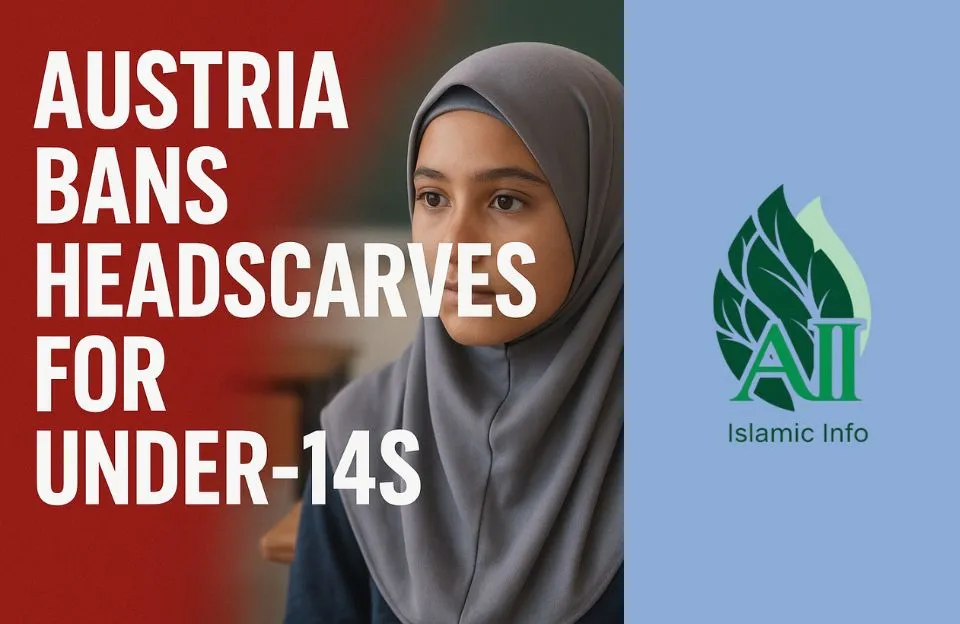
Austria Implements New Ban on Headscarves for Girls Under 14 in Schools
Austria has introduced a new nationwide law prohibiting girls under 14 from wearing headscarves in both public and private schools. The move, backed by the governing coalition of the ÖVP, SPÖ, and NEOS parties, is being presented as a step toward strengthening gender equality—though it has already sparked strong debate and criticism across the country.
Government officials argue that the legislation aims to “protect and empower young girls” by preventing what they describe as symbols of pressure or control. However, opponents believe the measure unfairly targets Muslim students and may violate constitutional protections.
A Wider Ban Than the Previous One
This new law follows a similar measure introduced in 2020, which banned headscarves for girls under 10. That law was annulled by Austria’s Constitutional Court, which ruled that it singled out Muslims and violated equality principles.
Learning from that ruling, lawmakers have expanded the new restrictions to include all students under 14 and have avoided explicitly naming Islam in the text. Nonetheless, the ban still applies to traditional Muslim head coverings, including the hijab and burka.
How the Ban Will Be Enforced
Schools will follow a multi-step process if a student violates the rule. The child and their guardians will first be invited for discussions with school authorities. Repeated violations may lead to the involvement of the child welfare agency. In more serious or persistent cases, families could face fines of up to €800 (approximately £700).
The government claims these penalties are meant to ensure compliance rather than punish families. Officials maintain the law is about safeguarding minors rather than policing religious practice.
Political Reactions: Divided Opinions
The decision has drawn mixed reactions across Austria’s political landscape:
- Supporters, such as NEOS parliamentary leader Yannick Shetty, insist the law serves to “protect the freedom and rights of young girls,” estimating that around 12,000 children may be affected.
- The far-right FPÖ, which also backed the measure, argued that the government’s action does not go far enough. The party wants a complete ban on headscarves for all students and school staff, claiming that “political Islam has no place in Austrian schools.”
- Opponents, including the Greens and multiple rights groups, strongly denounce the ban. Critics argue it is unconstitutional and fosters discrimination rather than equality.
Response from Austria’s Islamic Community
The Islamic Community in Austria (IGGÖ), the country’s official Muslim representative body, condemned the law, saying it violates fundamental rights and risks socially isolating Muslim girls.
In a statement, the IGGÖ emphasized that instead of empowering young students, the measure “will stigmatize and marginalize them,” and confirmed it is evaluating legal steps to challenge the law. The organization referenced the 2020 Constitutional Court ruling, which declared a similar ban unconstitutional.
Implementation Timeline
Austria plans to introduce an “awareness-raising phase” starting February 2026, during which schools will educate parents and students about the new rules. The full ban is scheduled to come into effect in September 2026, coinciding with the new academic year.
Whether the law will survive a constitutional review remains uncertain. As NEOS leader Shetty admitted, officials “have done their best” to avoid legal issues but cannot guarantee the ban will ultimately stand.