
Ramadan 2026 Moon Sighting Updates: Start Date Confirmed in Several Countries
As Muslims around the world prepare to welcome Ramadan 1447 AH, official moon-sighting announcements are beginning to shape the expected start date of the holy month. Religious authorities in multiple countries have completed their observations and confirmed when the first fast will be observed.
Moon sighting plays a central role in determining the beginning of Ramadan. While some nations rely solely on physical observation of the crescent moon (Hilal), others also use astronomical calculations. Because of these differences, the start of Ramadan can vary from country to country.
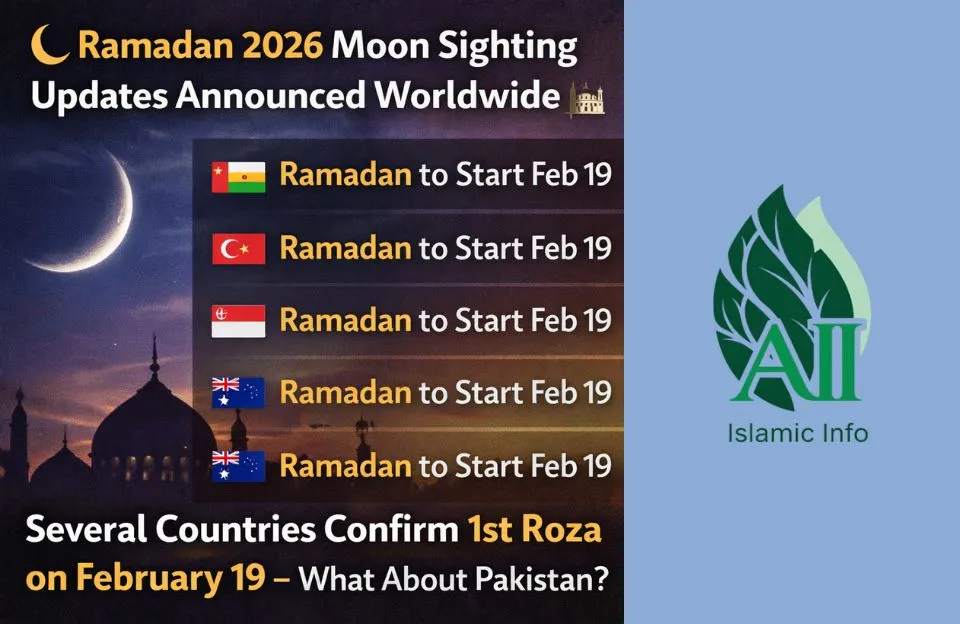
Ramadan 2026 Expected to Begin on February 19
Several countries have now confirmed that Ramadan will commence on Thursday, February 19, 2026, after announcing that the crescent moon was not sighted.
Australia Confirms Ramadan 2026 Date
The Australian Fatwa Council announced that, according to astronomical data, the Ramadan crescent was not visible. As a result, Ramadan 1447 AH will begin on Thursday, February 19, 2026. The first Taraweeh prayers will be offered after Isha on Wednesday, February 18, 2026.
Singapore Announces First Roza Date
In Singapore, the Islamic Religious Council of Singapore (MUIS) confirmed that the crescent moon set before sunset and could not be seen. Authorities have therefore declared that Ramadan will begin on February 19, 2026. Taraweeh prayers will also start on the evening of February 18.
Turkey Declares Ramadan Start
Turkey’s Presidency of Religious Affairs stated that astronomical assessments showed no visibility of the new moon. Officials confirmed that Ramadan 1447 AH will start on Thursday, February 19, 2026, with Taraweeh prayers on the preceding evening.
Oman Issues Official Announcement
Oman’s official Hijri Committee likewise confirmed that the crescent moon was not sighted. The country will begin fasting on February 19, 2026, and Taraweeh prayers will be observed after Isha on February 18.
Ramadan 2026 moon sighting Pakistan
The Central Ruet-e-Hilal Committee is scheduled to meet on the evening of Wednesday, February 18, to search for the crescent.
Scientific forecasts from SUPARCO and the PMD suggest the moon will be easily visible on that evening, making Thursday, February 19, the likely first day of fasting.
Official confirmation will be announced by Chairman Maulana Abdul Khabeer Azad after reviewing testimonies from zonal committees across the country.
Ramadan 2026 moon sighting India
Indian Hilal Committees in Delhi, Mumbai, and Lucknow will gather on February 18 to observe the sky after Maghrib prayers.
Most regional astronomers predict that the first Roza will fall on February 19, as the moon is unlikely to be sighted a day earlier.
Local religious authorities emphasize that while calculations point to Thursday, the official start depends strictly on a physical sighting of the hilal.
Ramadan 2026 moon sighting North America
The Fiqh Council of North America (FCNA) has already announced that Ramadan will begin on Wednesday, February 18, 2026.
This decision is based on astronomical calculations which confirm the new moon’s birth on February 17, meeting their criteria for a new lunar month.
While many communities follow this calendar, some local groups may still wait for a physical sighting report on the night of the 17th or 18th.
Ramadan 2026 moon sighting Saudi Arabia
The Saudi Supreme Court has officially called on citizens to participate in the moon sighting on the evening of Tuesday, February 17.
Astronomers suggest the crescent will be nearly impossible to see on Tuesday, making Thursday, February 19, the most probable start date for the Kingdom.
A final announcement is expected late Tuesday night, which will determine if Shaban lasts 29 or 30 days.
Why Ramadan Dates Differ Between Countries
Differences in moon visibility, geographic location, and religious methodology often result in varying Ramadan start dates across the world. Some countries prioritize local moon sighting, while others follow regional or global astronomical calculations.
With announcements already confirmed in several nations, attention now turns to other countries that are expected to release their official moon-sighting decisions soon.