Salat al-Istisqa to Be Observed at Masjid al-Haram and Masjid an-Nabawi on February 12, 2026
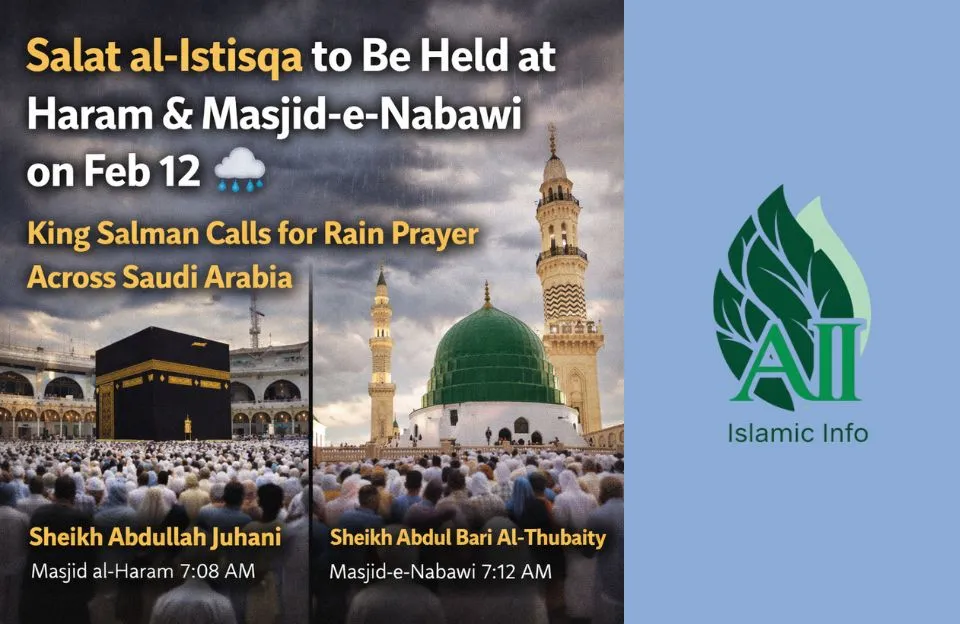
Makkah/Madinah: The Royal Court of Saudi Arabia has announced that Salat al-Istisqa, the special prayer for rain, will be performed across the Kingdom on Thursday, February 12, 2026, corresponding to 24 Sha’ban 1447 AH. The call for the congregational prayer was issued under the direction of the Custodian of the Two Holy Mosques, King Salman bin Abdulaziz Al Saud.
The official statement urged Muslims throughout Saudi Arabia to take part in the prayer, following the Sunnah of Prophet Muhammad ﷺ during periods of drought and limited rainfall. Salat al-Istisqa is traditionally offered in congregation, where worshippers gather in humility to seek Allah’s mercy and blessings for rain.
Prayer Timings at the Two Holy Mosques
At Masjid al-Haram in Makkah, Sheikh Dr. Abdullah Juhany will lead the Istisqa prayer at 7:08 AM. Meanwhile, at Masjid an-Nabawi in Madinah, Sheikh Dr. Abdul Bari Al-Thubaity will lead the congregation at 7:12 AM.
Thousands of worshippers are expected to attend the prayers at both holy mosques, while similar congregational prayers will be organized in cities and towns across the Kingdom.
A Prophetic Tradition During Drought
Salat al-Istisqa holds deep spiritual importance in Islamic tradition. It is performed when communities face dry conditions and a shortage of rainfall. The prayer serves as a reminder of human dependence on Allah’s mercy and sustenance.
Islamic teachings encourage believers to approach the prayer with sincerity, repentance, and humility. Scholars often remind worshippers to increase in charity, seek forgiveness (Istighfar), and strengthen their connection with Allah during such times.
The Prophet Muhammad ﷺ performed Salat al-Istisqa on several occasions, leading companions in heartfelt supplication for rain. The practice continues to be observed in Muslim communities worldwide whenever rainfall becomes scarce.
Nationwide Participation Encouraged
Saudi authorities have called on citizens and residents to participate in the prayer and engage in personal supplication. Mosques across the Kingdom will organize congregational prayers in accordance with official guidance from the Ministry of Islamic Affairs.
The Royal Court’s announcement reflects the Kingdom’s continued emphasis on preserving Islamic traditions and encouraging collective worship during significant moments. It also highlights the importance of unity and faith during environmental challenges.
Spiritual Significance for Muslims Worldwide
For Muslims around the world, especially those in Pakistan, India, Bangladesh, Indonesia, and other countries with strong religious ties to the Two Holy Mosques, the announcement carries spiritual significance. Many believers closely follow events taking place at Masjid al-Haram and Masjid an-Nabawi, viewing them as central to the global Muslim community.
The performance of Salat al-Istisqa at Islam’s two holiest sites is expected to draw global attention, with broadcasts likely to be aired on religious television channels and shared widely on social media platforms.
A Reminder of Faith and Gratitude
Religious scholars emphasize that beyond seeking rainfall, Salat al-Istisqa serves as a broader reminder of gratitude, repentance, and reliance on Allah. The gathering encourages reflection on blessings often taken for granted, including water, crops, and environmental balance.
As Thursday, February 12 approaches, worshippers across Saudi Arabia are preparing to take part in this important congregational prayer. The Kingdom’s leadership has once again underscored the value of spiritual unity, humility, and collective supplication during times of need.
Muslims are encouraged to attend the prayer, engage in remembrance of Allah, and offer sincere duas for rain, mercy, and blessings for the entire Ummah.